

Why ChatGPT Recommends Your Competitor and Not You
When ChatGPT names a competitor instead of you, it is rarely because they do better work. It is because they are easier for the assistant to find, easier to identify and easier to back up with other sources. Most of those reasons can be fixed in about a month.
If you have not tested this yet, start with how to check if ChatGPT recommends your business. This post is about what to do once you know the answer is “not you.”
Why does ChatGPT pick one business over another?
With web search on, ChatGPT runs a few searches, reads a handful of pages and writes an answer from what those pages agree on. Without web search, it falls back on what it learned in training, which mostly reflects how often and how consistently a business was written about. Either way, it favors the business that many sources describe the same way.
That is the whole game. The assistant is not judging your work. It is looking for agreement.
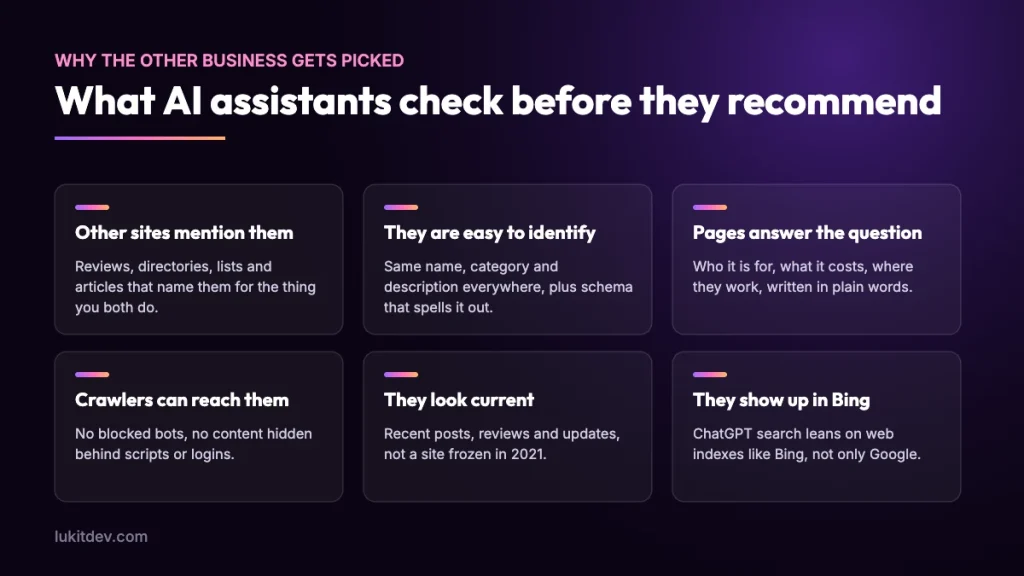
The six reasons it is picking them
1. Other sites mention them and not you
This is the big one. Look at the sources ChatGPT cites when it recommends your competitor: “best of” lists, review sites, industry directories, Reddit threads, podcast show notes, partner pages. If your competitor is on those pages and you are not, no amount of work on your own site closes the gap.
2. They are easy to identify
Their name, category and one-line description match everywhere: their site, LinkedIn, directories and review profiles. Their site has Organization or Person schema that states who they are and links to those profiles. If your company is described three different ways across the web, the assistant has a harder time being sure the mentions are about you.
3. Their pages answer the actual question
Buyers ask things like “who does WordPress maintenance for small law firms” or “how much does HubSpot onboarding cost.” A page that says who the service is for, what it includes and roughly what it costs gets quoted. A homepage that says “innovative digital solutions” does not.
4. Crawlers can reach them
If your robots.txt or Cloudflare settings block OpenAI’s search crawler, ChatGPT cannot read your pages when it searches. I see this more often than you would think, usually from a security setting nobody remembers turning on. Here is how to check if your website is blocking ChatGPT.
5. They look current
Recent posts, recent reviews and pages with visible update dates all signal that a business is still active. A site that has not changed since 2021 loses to one that changed last month.
6. They show up in Bing
ChatGPT’s search uses outside search providers, and Bing is widely reported to be one of them. Plenty of sites rank fine on Google and barely exist in Bing because nobody ever submitted a sitemap there. Bing Webmaster Tools is free and takes ten minutes to set up.
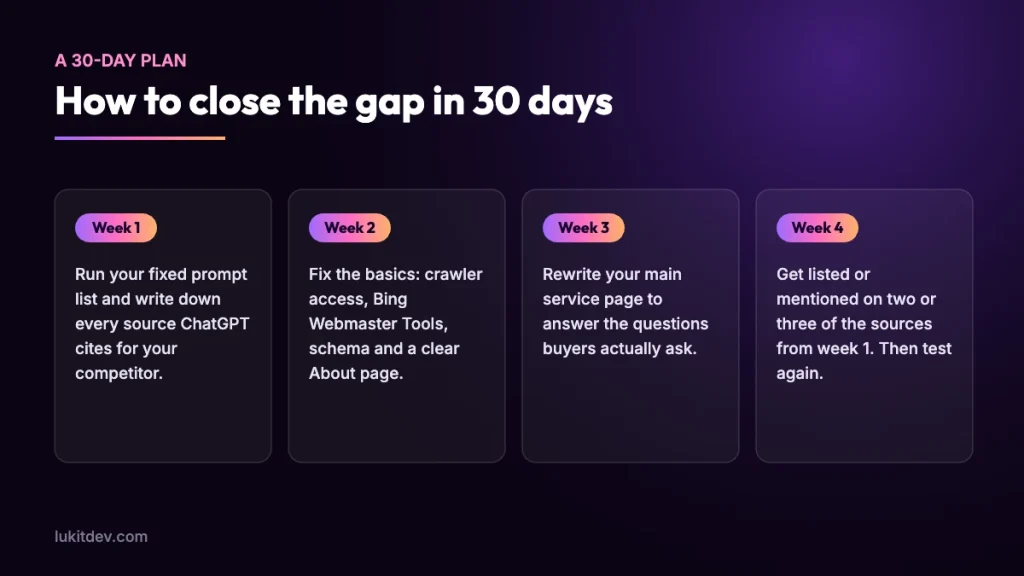
How to close the gap in 30 days
- Week 1: map the sources. Run your fixed list of buyer questions in ChatGPT with search on and write down every page it cites for your competitor. That list is your target list.
- Week 2: fix the basics. Check crawler access, set up Bing Webmaster Tools, add or fix your schema and make your About page say plainly who you are and what you do.
- Week 3: rewrite your main service page. Answer the questions buyers ask, in their words: who it is for, what it includes, what it costs and how it works.
- Week 4: get on the sources. Pick two or three pages from week 1 and get listed, reviewed or quoted on them. Then run the same questions again.
What not to do
Do not write “we are the best” on your own site and expect it to stick. Assistants care far more about what others say about you. Do not buy fake reviews or pay for spammy list placements either; those sources tend to get filtered out, and they can hurt you with Google too. And do not chase a single prompt. Track a fixed set of questions every month so you can see real movement.
When to get help
If you have done the basics and the same competitor still shows up every time, the gap is usually in the sources, and that takes a plan. This is what I work on in AI search optimization: I map which sources decide the answer in your market, fix what is on your site and help you get onto the pages that matter. Book a free 30-minute call and we can run a few of your buyer questions together.
Common questions
How long does it take to show up in ChatGPT?
Fixes like crawler access and Bing indexing can show up within a few weeks. New mentions on other sites usually take one to three months, because the assistant has to find those pages and see them agree with each other.
Can I pay ChatGPT to recommend my business?
No. Where OpenAI shows ads, they are labeled and kept separate from the answer, and they do not change what the answer says. What you can invest in is getting onto the directories, review sites and articles the assistant already cites.
Does ranking on Google still matter?
Yes. Pages that rank well in search are more likely to be found and cited, so SEO is still the foundation. The extra work for AI search is making your business easy to identify and getting mentioned on the sources assistants trust.

Lucas Alvarado — Senior marketing technology and web operations consultant. HubSpot, Salesforce, Pardot, and high-traffic WordPress for B2B revenue teams. Based in Miami, working with companies across the US.