

How to Check if ChatGPT Recommends Your Business
To find out whether ChatGPT recommends your business, ask it the questions your buyers ask, with web search on, and write down who it names and which sources it cites. Then check GA4 for visits from chatgpt.com. The prompts tell you where you stand, and the traffic tells you whether it is turning into visits.
Most owners I talk to have typed their own company name into ChatGPT once and called it research. That only tells you whether it knows you exist. Buyers do not search for you by name. They ask for a recommendation, and that is the test that matters.
Which prompts should I test?
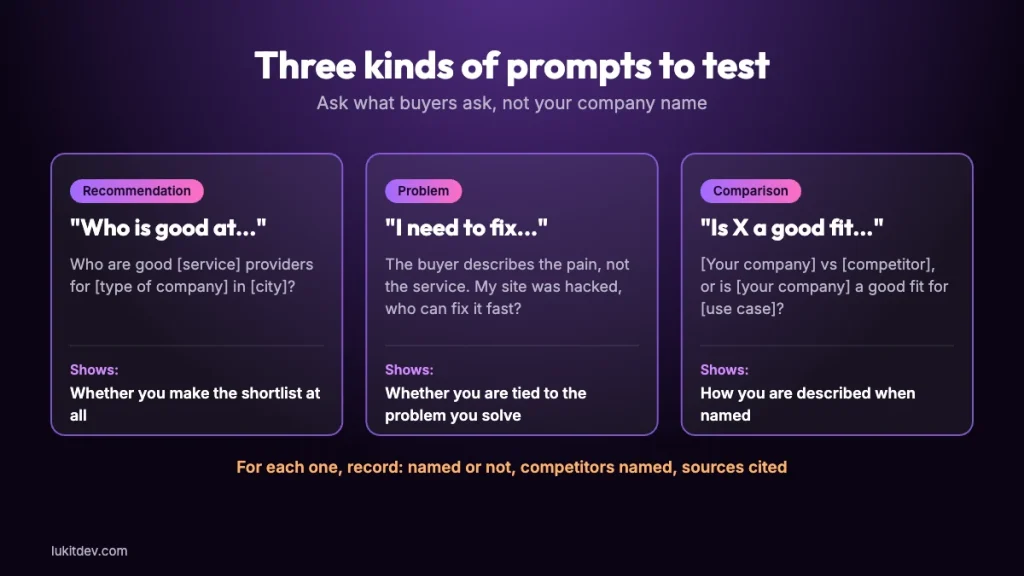
Write 15 to 20 questions a real buyer would type, in their words, not yours. Mix three kinds:
- Recommendation: “Who are good [service] providers for [type of company] in [city]?”
- Problem: “My WordPress site was hacked, who can fix it fast?” The buyer describes the pain, not the service.
- Comparison: “[Your company] vs [competitor]” or “Is [your company] a good fit for [use case]?”
Keep the list fixed. If you change the questions every month, you cannot tell whether anything moved.
How do I run the test so the results mean something?
- Use a logged-out or temporary chat. Memory and past conversations change the answers. You want what a stranger sees.
- Make sure the answer uses web search. Answers grounded in a search show sources you can click. Answers from the model’s training data alone often do not, and they can be months out of date.
- Run each prompt more than once. The answers vary from run to run. Count how often you appear, not whether you appeared once.
- Record three things per prompt: whether you were named, which competitors were named, and which pages were cited as sources.
- Repeat it in the other assistants your buyers use, such as Gemini, Perplexity, Claude and Google’s AI Overviews. They pull from different sources and rarely agree.
The cited sources are the most useful column. They show which directories, review sites, articles and competitor pages the assistant trusts for your category. If you are missing from those, that is usually the gap to close, not your own homepage copy.
How do I see ChatGPT traffic in GA4?
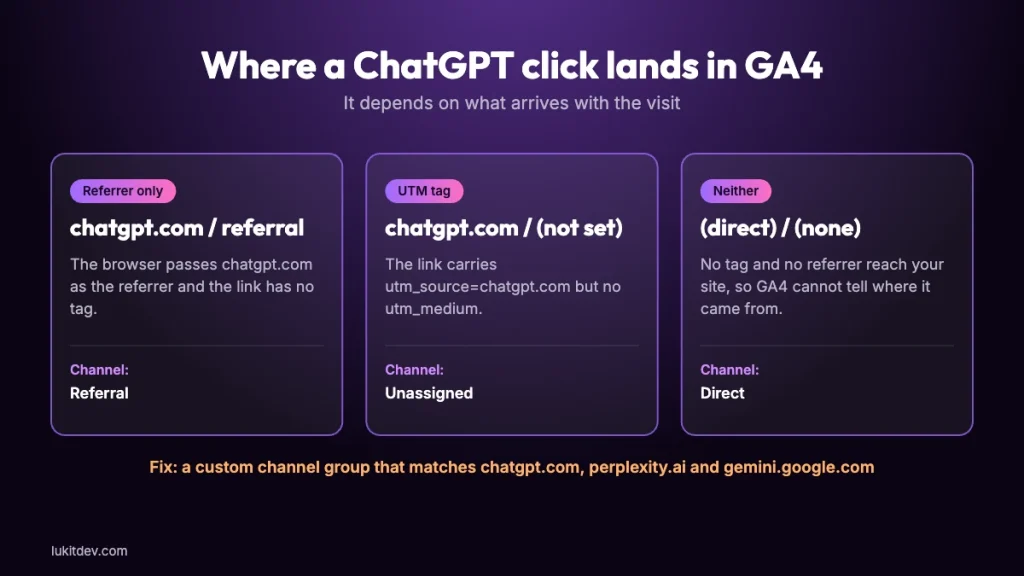
ChatGPT adds utm_source=chatgpt.com to links in answers that come from web search, so most of those visits show up in GA4 with chatgpt.com as the session source. There are two catches:
- The tag sets a source but no medium, so GA4 can file these visits as Unassigned instead of Referral. Look at session source, not just the channel report.
- Some clicks arrive with no tag and no referrer, and land in Direct. For about a week in October 2026, a ChatGPT bug dropped the tag, so a sudden dip is not always real.
The quickest fix is a custom channel group in GA4 that matches sources such as chatgpt.com, perplexity.ai and gemini.google.com and sits above Referral. Then AI traffic gets its own line you can watch each month.
What if ChatGPT never mentions me?
Start with the boring check: make sure your site is not blocking OpenAI’s search crawler, which I covered in is your website blocking ChatGPT. Then look at the sources the assistants cited for your prompts and ask why you are not on them. Usually it comes down to thin service pages, no clear statement of what you do and for whom, and no presence on the third-party sites they trust.
This is the audit I run as part of AI search optimization: a fixed prompt set across the major assistants, a list of the sources that decide who gets named, and the fixes in order of impact.
Common questions
How often should I re-run the test?
Monthly is enough for most businesses. The answers shift as the assistants update and new pages get published, and a month gives your changes time to show up.
Why does ChatGPT recommend a competitor with a worse website?
Often because other sites mention them and not you. The assistants cite third-party pages such as directories, reviews and articles, and a competitor that shows up there can beat a better homepage.
Is this the same as SEO?
It overlaps. Pages that rank well in search tend to get cited, so SEO still matters. The extra work is making your business easy to identify and getting mentioned on the sites the assistants trust.

Lucas Alvarado — Senior marketing technology and web operations consultant. HubSpot, Salesforce, Pardot, and high-traffic WordPress for B2B revenue teams. Based in Miami, working with companies across the US.